
Virtual Assistant Problems: Why Your Business Feels Stuck | DSG Digital
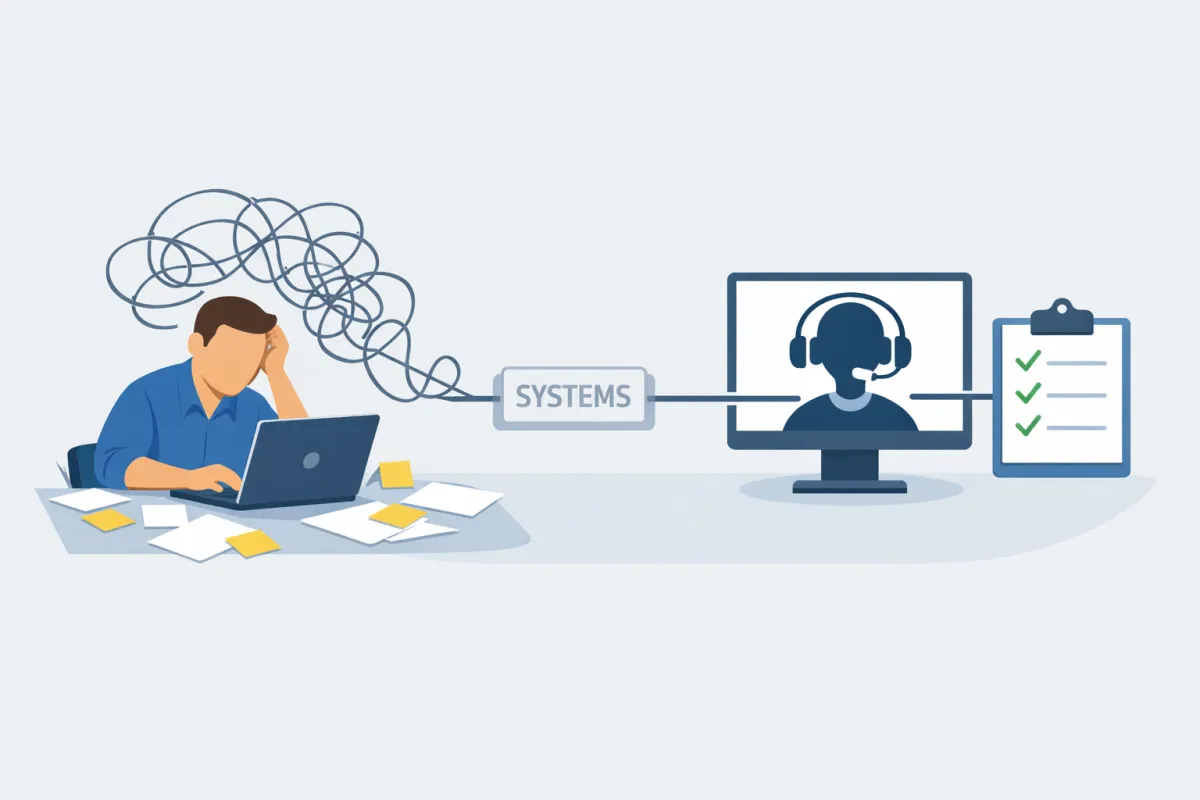
You hired a virtual assistant to buy back your time. You went through the process of finding someone, explaining your business, and handing off tasks. And yet, three months later, you're still the bottleneck. Emails still pile up. You're still putting out fires. You're still the one who knows where everything is.
This is one of the most common complaints from Canadian small business owners who've tried VAs, and it's rarely about the person they hired. The problem is almost always structural.
Here's what's actually going wrong, and what a setup that actually works looks like.
The Setup That Almost Always Backfires
Most business owners hire a VA the same way they'd hire a contractor: post a job, find someone, hand off tasks, hope for the best. The assumption is that having a capable person on the other end is enough.
It isn't.
Without a clear operating structure, even the best VA will underperform. They'll spend time guessing at priorities, waiting for direction, or defaulting to low-value tasks because those are the ones with obvious instructions. Meanwhile, you're still managing the things that matter most because you never had time to document how you actually do them.
The result: you've added a staff member but not reduced your workload. That's not a VA problem. It's an onboarding and systems problem.
Five Signs Your VA Setup Is the Problem
Before blaming a VA (or giving up on VAs altogether), run through this checklist.
1. You're still the system
If your VA can't do anything without asking you first, the knowledge hasn't transferred. This usually means onboarding was rushed or skipped entirely. A VA working without documented processes will always default to asking rather than acting. That means every task still runs through you.
2. There's no backup
Freelance and independent VAs are typically solo operators. When they're sick, travelling, or overbooked with another client, your operations stop. If one person's availability controls whether your business runs smoothly, you haven't solved a staffing problem, you've just created a single point of failure.
3. Onboarding took weeks (or never finished)
A good VA engagement should be operational within days. If you spent the first month going back and forth on logistics, access, and task scoping, that lag is a sign of a poorly structured intake process. By the time the VA was ready, you may have already lost confidence in the arrangement.
4. You have no clear picture of what they're doing
If you can't tell, at any given moment, what your VA is working on and whether it's moving the needle, you don't have accountability built into the engagement. A VA arrangement without regular reporting is essentially an honor system. Some people operate fine that way. Most don't.
5. The bottleneck just moved
Maybe the admin tasks got handled, but now approvals are backed up on your end. Or maybe the VA finished what you asked for but has nothing queued up next. Delegation without a task pipeline creates gaps and idle time. You haven't freed yourself up; you've just redistributed where things are getting stuck.
Why Most Small Business VA Setups Are Structurally Broken
The issue isn't that VAs don't work. It's that most engagements are set up as informal, trust-based arrangements with no real operating infrastructure.
Here's what that looks like in practice:
• Task handoffs happen through Slack or email with no clear scope or deadline
• There are no SOPs, so every task requires a new explanation
• The VA is working in isolation with no oversight or QA
• Hours and deliverables are tracked inconsistently, if at all
• There's no escalation path when something goes wrong
In this kind of setup, the VA is essentially managing themselves. That works fine for highly experienced operators with sharp self-direction. But for most businesses, it produces inconsistent output and a nagging sense that you're not getting full value for what you're paying.
The fix isn't to find a better VA. It's to build a better engagement model.
What a Structured VA Engagement Actually Looks Like
A well-structured VA engagement has a few things in place from day one:
• Clear scope: defined task types, priorities, and boundaries so the VA can act without constant check-ins
• Documented processes: SOPs built early in the engagement that capture how your business actually operates
• Regular reporting: a weekly cadence that shows what got done, what's pending, and where hours went
• Backup coverage: a second person who can step in when your primary VA is unavailable
• Oversight: someone monitoring output quality and performance, not just task completion
This is the difference between hiring a freelancer and working with a structured operations support service. The former gives you a person. The latter gives you a system.
The Canadian Small Business Reality
Canadian founders, particularly those running businesses in the $100K to $500K range, often hit the same wall. Revenue is solid enough that you need real support, but not so large that hiring a full-time operations coordinator makes financial sense. Payroll, benefits, and the overhead of employment add up fast.
The instinct is to go offshore or find the cheapest option on a freelance platform. Sometimes that works. Often, it produces exactly the virtual assistant problems described above: inconsistent availability, quality that varies by week, and the management burden falling right back on you.
What tends to work better is a service with a fixed monthly cost, predictable capacity, and built-in accountability. You know what you're getting, you know how many hours you have, and someone else is responsible for making sure the work is done right.
Sprint Projects: A Different Way In
Not every business is ready for a monthly retainer right away. Sometimes the immediate need is a specific, bounded project: a CRM migration, a content backlog, a system setup, event coordination.
Sprint-based engagements work well here. A fixed scope, a fixed timeline of two to six weeks, and a fixed price. You get the output without committing to an ongoing arrangement. And if the experience goes well, it's a natural starting point for a longer relationship.
This kind of project work also surfaces a lot of the operational issues that a monthly VA would eventually hit anyway. Getting those resolved upfront makes any ongoing support significantly more effective.
When to Reconsider Your Current Setup
If you're experiencing any of the following, your current VA arrangement isn't working as well as it should:
• You dread checking in with your VA because it always turns into more work for you
• You've lost track of what hours were used or what got done
• Your VA is unavailable and you have no fallback
• You've considered cancelling multiple times but don't know what the alternative is
• The tasks that are getting done are low-priority, while the important stuff still sits on your plate
None of this means VAs don't work. It means the current arrangement isn't working. That's fixable.
Getting This Right With DSG Digital
DSG Digital offers virtual assistant and operations support for Canadian founders and small teams. Engagements start in two to three business days, come with backup coverage built in, and include weekly written status reports so you always know where things stand.
Packages run from a 20-hour Quickstart option at $600/month up to full-time equivalent coverage at $4,100/month. Sprint projects are available from $1,500 for businesses that need a defined scope of work rather than ongoing support.
There are no long-term contracts. Month-to-month with 30 days' notice.
If your current VA setup isn't delivering what you expected, or if you've been running everything yourself and are ready to change that, a discovery call is a good starting point. You'll come out of it with a clear picture of what structured support would look like for your business specifically.
Book your call at dsg-digital.com or reach out at [email protected].